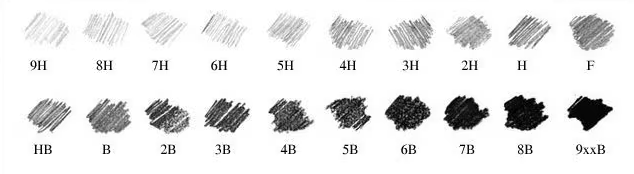
Pick up a graphite pencil and you will see a code stamped on the side — HB, 2B, 4H, or something similar. These letters tell you how hard or soft the lead is, which directly affects how dark your marks appear and how the pencil feels on paper.
The basics: H and B
Graphite pencils use a simple two-part scale:
- H (Hard) — harder lead, lighter marks, holds a sharp point longer. Good for fine lines and light sketching.
- B (Black / soft) — softer lead, darker marks, wears down faster. Good for shading and bold drawing.
The number before the letter tells you how much — higher numbers mean more extreme. A 4H is harder and lighter than a 2H. A 6B is softer and darker than a 2B.
HB — the middle ground
HB sits in the centre of the scale. It is the pencil most people reach for without thinking — the one in offices and classrooms. It writes comfortably, erases cleanly, and works for everyday sketching. If you only own one pencil, HB is a sensible default.
Common grades and what to use them for
2H and H — light construction lines
Hard pencils press lightly into the paper and leave faint grey marks. Use them for initial sketches you plan to ink or paint over, technical drawing, or any time you want structure without heavy lines showing through.
HB and F — general drawing
HB handles everyday sketching well. F (Fine point) is slightly harder than HB and holds its tip a little longer — useful for detailed work where you want consistent line weight.
B and 2B — sketching and shading
These are the workhorses for artists. B gives you a noticeably darker line with less pressure. 2B is softer still — lovely for quick sketches, gesture drawing, and building up light shadows. Most sketchbooks are started with a 2B.
4B and 6B — rich dark tones
Soft pencils lay down graphite quickly, making them ideal for deep shadows, expressive drawing, and blending with a finger or stump. The trade-off: they smudge easily and are harder to erase completely. Reach for 4B or 6B when you want drama, not precision.
Quick reference
- Harder (H) → lighter, sharper, less smudging
- Softer (B) → darker, smoother, more smudging
- HB → balanced, all-purpose
Woodcase vs mechanical pencils
Traditional wooden pencils let you vary line weight by sharpening and tilting. Mechanical pencils keep a consistent width — useful for technical sketching and clean lines. For learning shading and expressive drawing, woodcase pencils in a few grades usually feel more natural. Many artists use both: mechanical for layout, woodcase for tone.
Sharpening matters
A blunt pencil forces you to press harder, which darkens marks unevenly and flattens detail. Sharpen often for crisp lines. A craft knife lets you expose more lead for broad shading; a handheld sharpener is fine for everyday sketching. Keep a small sharpener in your bag if you draw outside.
Mixing grades in one drawing
Professional sketches rarely use a single pencil. A typical approach:
- 2H or H — light layout and proportions
- HB or 2B — main contours and mid-tones
- 4B–6B — deepest shadows and accents
Start light, build dark. Soft pencils over hard lines give you control without muddying the page.
Smudging and fixing
Soft B-grade pencils smudge with your hand. Rest your palm on a scrap paper lift to avoid dragging graphite. A fixative spray can protect finished drawings, but for practice sketches a kneaded eraser and clean paper are enough.
Once you know the scale, choosing a pencil becomes straightforward. Match the grade to the job — light guidelines, finished sketch, or deep shadow — and let the right tool do the work.