
Vincent van Gogh (1853–1890) is famous for swirling starry nights and sunflowers in thick paint — but behind those canvases lies something quieter: hundreds of drawings. He sketched constantly, and his sketchbooks are a masterclass in looking hard and drawing fast.
Drawing before painting
Van Gogh did not treat drawing as a lesser medium. For years he drew almost exclusively — peasants, wheat fields, trees, hands, boots — building the eye and hand he would later bring to colour. He wrote to his brother Theo that he wanted to "get to the point where I can draw anything I see."
What his sketches look like
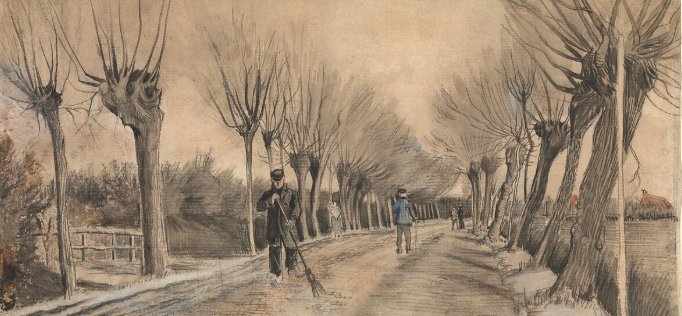
His drawing style is unmistakable: restless, rhythmic lines that follow the direction of a form rather than tracing its outline. He used reed pens, graphite, and chalk on cheap paper. Proportion was not always perfect — but energy and honesty were always present.
- Directional hatching — lines follow the curve of a face or the slope of a field.
- Speed — many sketches feel captured in minutes, not hours.
- Repetition — he drew the same subjects again and again until he understood them.
The sketchbook as laboratory
Before committing paint to canvas, van Gogh tested compositions in small drawings. A letter to Theo might include a quick sketch of a scene he planned to paint. The sketchbook was where ideas were cheap — mistakes cost only a sheet of paper.
Periods of his drawing life
Early Dutch work is dark and heavy — peasants, boots, hands, cottages. In Paris he studied Japanese prints and loosened his line. In Arles and Saint-Rémy, drawings became faster and more rhythmic, often made with a reed pen dipped in ink. Tracking those shifts shows that style is not fixed; it responds to place and practice.
Tools he favoured
- Reed pen — scratchy, variable line; unforgiving but lively
- Graphite and chalk — softer studies and tonal work
- Cheap paper — he drew on whatever was available; perfection of surface was never the point
"I tell you, if one keeps on drawing, one draws so much more easily and more quickly." — Vincent van Gogh, in a letter to Theo
What beginners can learn
You do not need to copy van Gogh's style to learn from his habit. Three principles transfer directly:
- Draw every day — even ten minutes counts.
- Draw ordinary things — chairs, shoes, trees, hands.
- Let drawings be unfinished — not every page needs to be a masterpiece.
Van Gogh produced over 1,000 drawings in his lifetime. The lesson is not genius — it is volume. Keep a sketchbook, fill it without judgement, and let the habit do the work.