
Line gets you started; shading makes a sketch feel solid. You do not need twenty techniques — five cover almost every beginner drawing. Practice each on a circle or square before using it on a real subject.
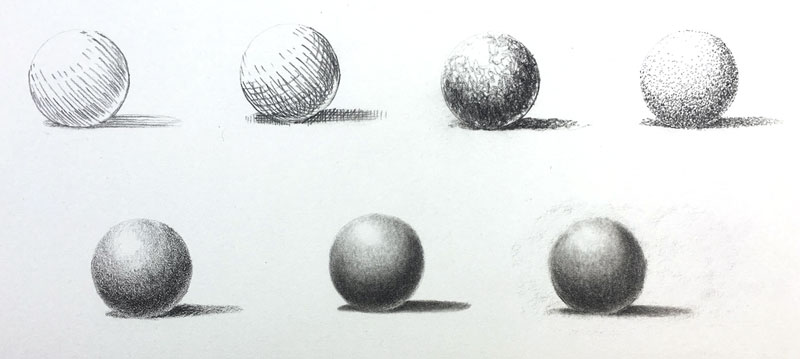
1. Hatching
Parallel lines drawn close together. The closer the lines, the darker the tone. Keep strokes consistent in direction for a clean look, or follow the form of the object so lines wrap around a cylinder or cheek. Use a sharper HB or 2B and light pressure at first.
2. Cross-hatching
A second layer of lines crossing the first — usually at roughly ninety degrees. Builds darker values without smudging. Old masters used cross-hatching for everything from portraits to fabric. Vary the angle slightly on curved surfaces to suggest roundness.
3. Blending
Soft graphite (2B–6B) laid down then smoothed with a finger, tissue, or blending stump. Fast and atmospheric; easy to overdo. Keep one area blended and leave edges crisp for contrast. A kneaded eraser can pull highlights back out of blended zones.
4. Stippling
Dots instead of lines. Slow but precise — excellent for texture (orange peel, rough stone, distant foliage). More dots = darker. Rest your hand on a pivot point and work in small clusters rather than random scatter.
5. Contour shading
Lines that follow the three-dimensional form — like latitude lines on a globe. Powerful for showing volume on arms, apples, and hills. Combine with light hatching for shadows that feel wrapped around the subject.
Putting it together
Most sketches mix techniques: hatching for mid-tone, cross-hatching for deep shadow, a touch of blending on skin or sky, stippling for one textured accent. Try shading one apple five ways — same object, five squares, five methods.
"Light and shade are the great promoters of form." — Leonardo da Vinci
Common shading mistakes
- Only outlining — add tone inside the shape, not just around the edge
- Flat grey everywhere — push darkest darks and leave brightest lights
- Smudging the whole page — blend selectively, not by default
- Random line direction — let strokes follow form when possible
Shading is handwriting for volume — repetitive, personal, improvable. One page of spheres and cubes this week will show up in every sketch you draw next month.