
Leonardo da Vinci (1452–1519) painted the Mona Lisa — but he may have spent more time with a sketchbook than a brush. Thousands of his drawings survive: quick studies of hands, birds in flight, water spirals, machines, and faces. For Leonardo, sketching was not preparation for "real" art. It was the art of thinking.
The notebook habit
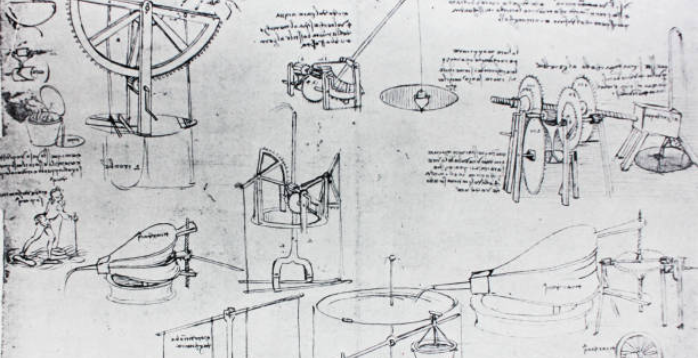
Leonardo carried small notebooks everywhere, filling them with observations written backwards in mirror script — partly to keep his notes private, partly because he was left-handed and it kept the ink from smudging. A single page might hold a study of a horse's leg, a note about how light bends through water, and a rough map of a river.
Nothing was too small to draw. That openness is what makes his sketchbooks feel modern — they read like the mind of someone who never stopped asking questions.
What his sketches look like
Leonardo's drawing style shifted with the subject, but a few qualities show up again and again:
- Soft contour — edges built from many light strokes instead of a single hard outline.
- Cross-hatching — layers of fine lines creating shadow and volume.
- Restless revision — figures drawn, redrawn, and adjusted until the pose felt alive.
His silverpoint and chalk studies of drapery and anatomy remain among the finest drawing exercises in Western art — not because they are finished paintings, but because they show the process of seeing.
Drawing to understand
Leonardo did not sketch only what looked beautiful. He drew to understand — how a wing folds, how muscles pull beneath skin, how water moves around an obstacle. His famous Vitruvian Man began as a measured drawing problem. His studies of turbulent water look like abstract patterns until you realise he was trying to capture physics on paper.
Materials he used
Leonardo worked in silverpoint (fine lines on prepared paper), red and black chalk, and ink. Silverpoint cannot be erased — every mark is a commitment. That may explain the careful, searching quality of his early studies. Later notebooks mix quick ink notes with small diagrams, like a modern engineer's journal.
Pages worth looking up
- Studies of hands and drapery — patience made visible in repeated curves
- Birds in flight — motion broken into sequential poses
- Water and hair — chaos organised into pattern through observation
- Machine sketches — drawing as invention, not decoration
"Learning never exhausts the mind." — Leonardo da Vinci
What beginners can learn
You do not need Leonardo's genius to borrow his method. Try these three habits from his notebooks:
- Carry a small sketchbook — draw what you notice, not what you think you should draw.
- Ask one question per page — how does this fold? why does this curve? what happens if I change the angle?
- Leave drawings unfinished — Leonardo's best pages often stop mid-thought, and that is the point.
Leonardo proved that a pencil and paper can be a laboratory. Sketch to look, sketch to wonder, and let the hand teach the eye what words cannot.