
Katsushika Hokusai (1760–1849) is one of the most recognisable names in art history — and one image stands above the rest. The Great Wave off Kanagawa has appeared on posters, phone cases, and museum walls worldwide. But behind that single print lies a lifetime of drawing, reinvention, and an artist who believed he was only getting started in his seventies.
A life of many names
Hokusai changed his artistic name more than thirty times over his career — each shift marking a new direction. He worked as a book illustrator, a painter of festival banners, a designer of surimono (luxury prints), and finally as the creator of landscape series that would define ukiyo-e for centuries.
He did not treat art as a single identity. He treated it as something to keep learning — a habit that beginners can borrow even if they never touch a woodblock.
What makes The Great Wave work
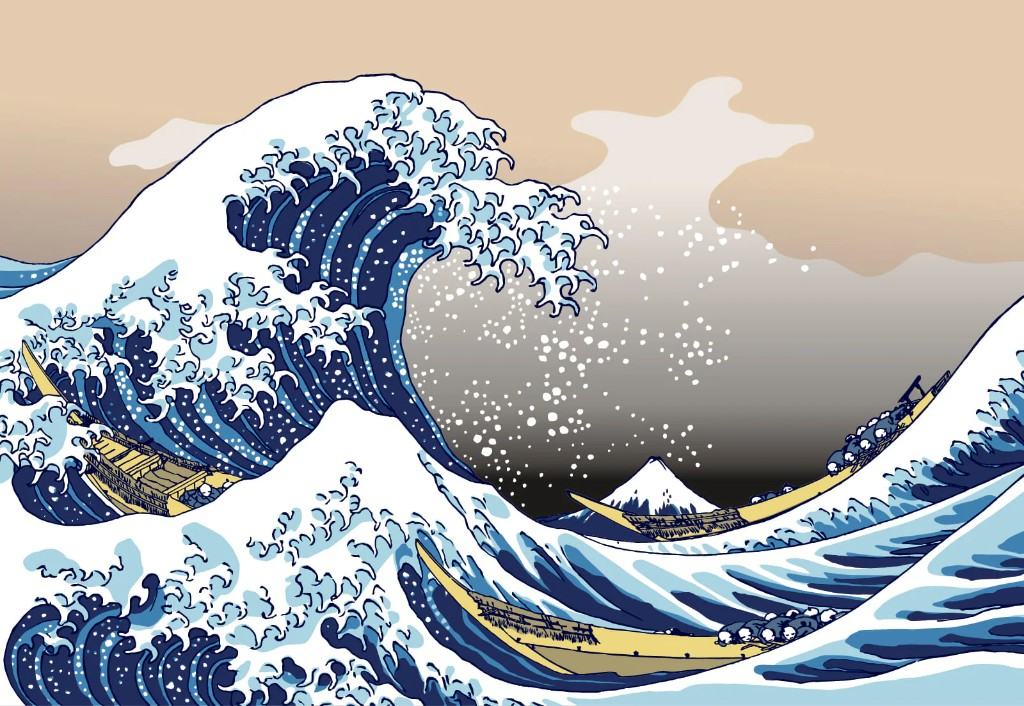
Look past the fame and the print is a lesson in composition. Hokusai places Mount Fuji small and calm in the distance while the wave dominates the foreground — scale and stillness in tension with chaos.
- Bold silhouette — the wave's claw-like foam reads instantly, even at thumbnail size.
- Prussian blue — a synthetic pigment newly available in Japan, used here with depth and contrast.
- Diagonal energy — the wave, boats, and horizon all pull the eye in different directions, creating movement without blur.
- Human scale — tiny rowers remind us this is not abstract pattern; it is nature threatening people.
Thirty-Six Views of Mount Fuji
The Great Wave belongs to a series of forty-six prints (despite the title) showing Fuji from bridges, fields, markets, and shores. Fuji is often small — a stable anchor while life swirls around it. Studying the whole series teaches composition more than copying one famous image.
Hokusai Manga
His sketchbooks — published as Hokusai Manga — are encyclopaedic: animals, workers, gods, architecture, jokes. They were reference books for other artists and proof that he drew from life constantly. Beginners sometimes treat sketchbooks as precious; Hokusai treated his as a warehouse of ideas.
Drawing before printing
Ukiyo-e prints were collaborations: the artist drew the design, a carver cut the woodblocks, and a printer applied colour layer by layer. Hokusai's original drawings had to be clear enough to survive that process — every line intentional, every shape readable. That discipline — bold readable shapes — is exactly what sketchers practice when they simplify a scene to a few lines.
"From the age of six I had a mania for drawing… At seventy-three I finally learned something about the true nature of things. When I am eighty I shall progress further; at ninety I shall penetrate their mystery." — Hokusai
What beginners can learn
You do not need to make woodblock prints to study Hokusai. Three ideas transfer directly to a sketchbook:
- Simplify shapes — reduce a scene to a few strong silhouettes before adding detail.
- Play with scale — make one element huge and another tiny to create drama.
- Keep going — Hokusai's best-known work came late in life, after decades of practice.
The Great Wave is not a fluke of genius. It is the product of a long career spent drawing, observing, and starting over. Keep your lines bold, your subjects simple, and your practice steady — the wave will come.